
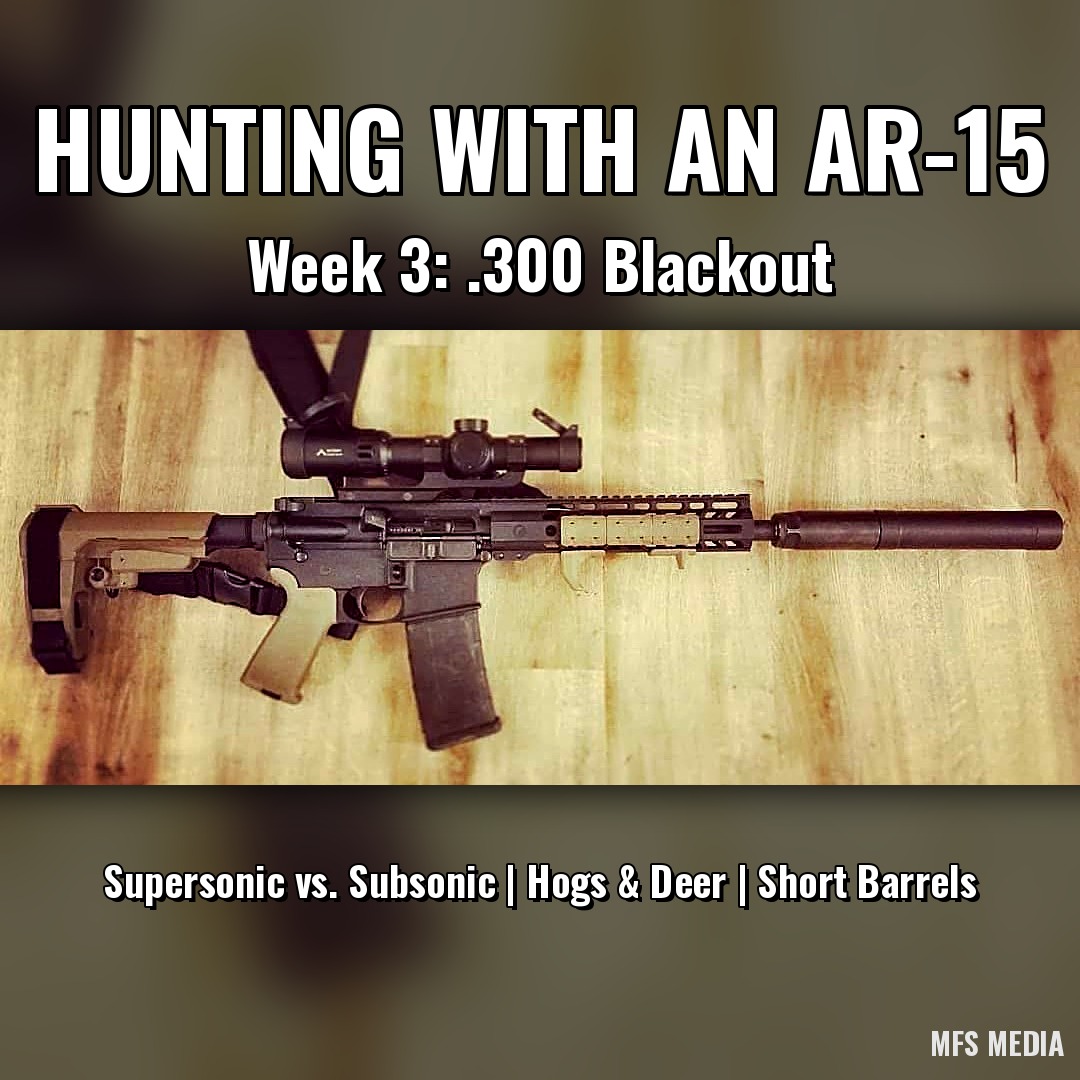
Last week we covered the .223 Remington and 5.56 NATO, the cartridges most AR-15s leave the factory with. They're fast, flat and easy to shoot, but they're still a .22-caliber bullet. This week we're stepping up to a .30-caliber bullet without leaving the AR-15 platform: the .300 AAC Blackout, usually just called .300 BLK.
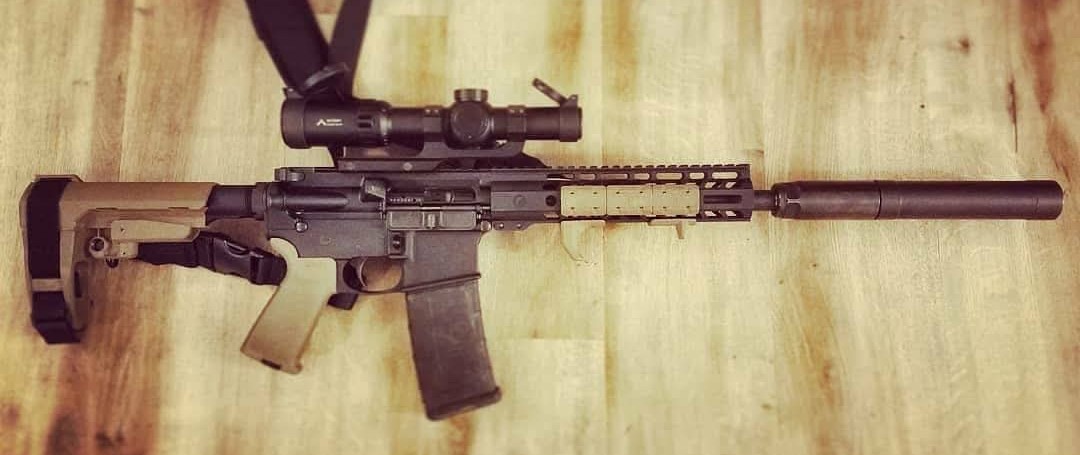
This one is personal for me. I hunt deer with a .300 Blackout AR that has a 10.5" barrel, a Griffin Armament suppressor and a Primary Arms SLx 1-6x24 scope with the .300 Blackout ACSS reticle, pictured here. It's the rifle I'm drawing on for this article.
What .300 Blackout actually is
The .300 Blackout came out of Advanced Armament Corporation (AAC), working with Remington Defense. A military customer wanted to shoot .30-caliber bullets from an M4 using the normal bolt and full-capacity magazines. AAC took an older wildcat idea, a .221 Fireball case necked up to hold a .308-inch bullet (the same concept as J.D. Jones's .300 Whisper), and nailed down the final specs. SAAMI, the U.S. industry standards body, accepted it on January 17, 2011.
The .221 Fireball is a shortened member of the .222/.223 Remington family, so the .300 BLK keeps the same case head as the 5.56. That's the whole trick. It fires the same .308-inch bullet diameter as a .308 Winchester or .30-06, but:
- It uses a standard AR-15 lower receiver.
- It uses the standard 5.56 bolt.
- It feeds from standard AR-15 magazines at full capacity.
- The only part that changes is the barrel.
So .300 Blackout is a true AR-15 (small-frame) cartridge. You don't need an AR-10 or a different action. If you already own an AR-15, a .300 BLK upper turns it into a .30-caliber rifle. Palmetto State Armory, for example, sells complete .300 Blackout uppers for the AR-15.
AAC listed its design goals plainly. One was to match 7.62x39 (AK) ballistics with supersonic ammo. Another was to be an ideal platform for suppressed fire. Both of those goals matter for hunting.
Two cartridges in one: supersonic and subsonic
This is the part that confuses people. The .300 BLK is loaded two very different ways.
Supersonic loads use bullets of about 110 to 135 grains, pushed around 2,100 to 2,400 fps from a 16-inch barrel. Here are the factory numbers (Hornady figures are from a 16" test barrel):
| Load | Muzzle | 100 yd | 200 yd |
|---|---|---|---|
| Hornady 110 gr V-MAX (Hornady BLACK) | 2,375 fps / 1,378 ft-lb | 2,094 fps / 1,071 ft-lb | 1,834 fps / 821 ft-lb |
| Barnes VOR-TX 110 gr TAC-TX (all copper) | 2,350 fps / 1,349 ft-lb | — | — |
| Barnes VOR-TX 120 gr TAC-TX BT (all copper) | 2,100 fps / 1,175 ft-lb | — | — |
| Hornady Custom 135 gr FTX | 2,085 fps / 1,303 ft-lb | 1,811 fps / 983 ft-lb | 1,564 fps / 733 ft-lb |
Barnes lists the 120 gr VOR-TX at 2,100 fps and 1,175 ft-lb at the muzzle. That's the load I run. The listing doesn't say which test barrel produced that number, so a short 10.5" barrel like mine can give up some velocity from that number.
Subsonic loads use heavy bullets, usually 190 to 220+ grains, kept under the speed of sound (about 1,126 fps in dry air at 68°F). Hornady's 190 gr Sub-X leaves the muzzle at 1,050 fps with 465 ft-lb and still carries 420 ft-lb at 100 yards.
Subsonic ammo exists for one big reason: with a suppressor, there's no sonic crack from the bullet, so the rifle is dramatically quieter.
For hunting, here's the reality. Most bullets need speed to expand, and at around 1,000 fps a typical subsonic match or FMJ bullet just pokes a .30-caliber hole. That's a poor choice for deer-size game. If you hunt with subsonics, use a bullet built for it. Hornady's Sub-X, for example, uses a flat profile, a grooved jacket and a soft Flex Tip so it opens at low speed. Even then, you're working with about a third of the energy of a supersonic load, so keep the shots close and the angles clean. For most deer hunters, supersonic hunting ammo is the right call. If you want to try the Hornady loads from this article, Brownells carries the 110 gr V-MAX, the 135 gr FTX and the 190 gr Sub-X.
What it's good for
Hogs. This is where .300 BLK really shines. Hogs are often shot at close range, at night, or in thick cover, sometimes several at a time. A .30-caliber expanding bullet out of a short, handy (and often suppressed) AR is a good tool for that work. If you hunt hogs after dark where it's legal, ATN is one company that makes thermal and night vision riflescopes for that kind of hunting.
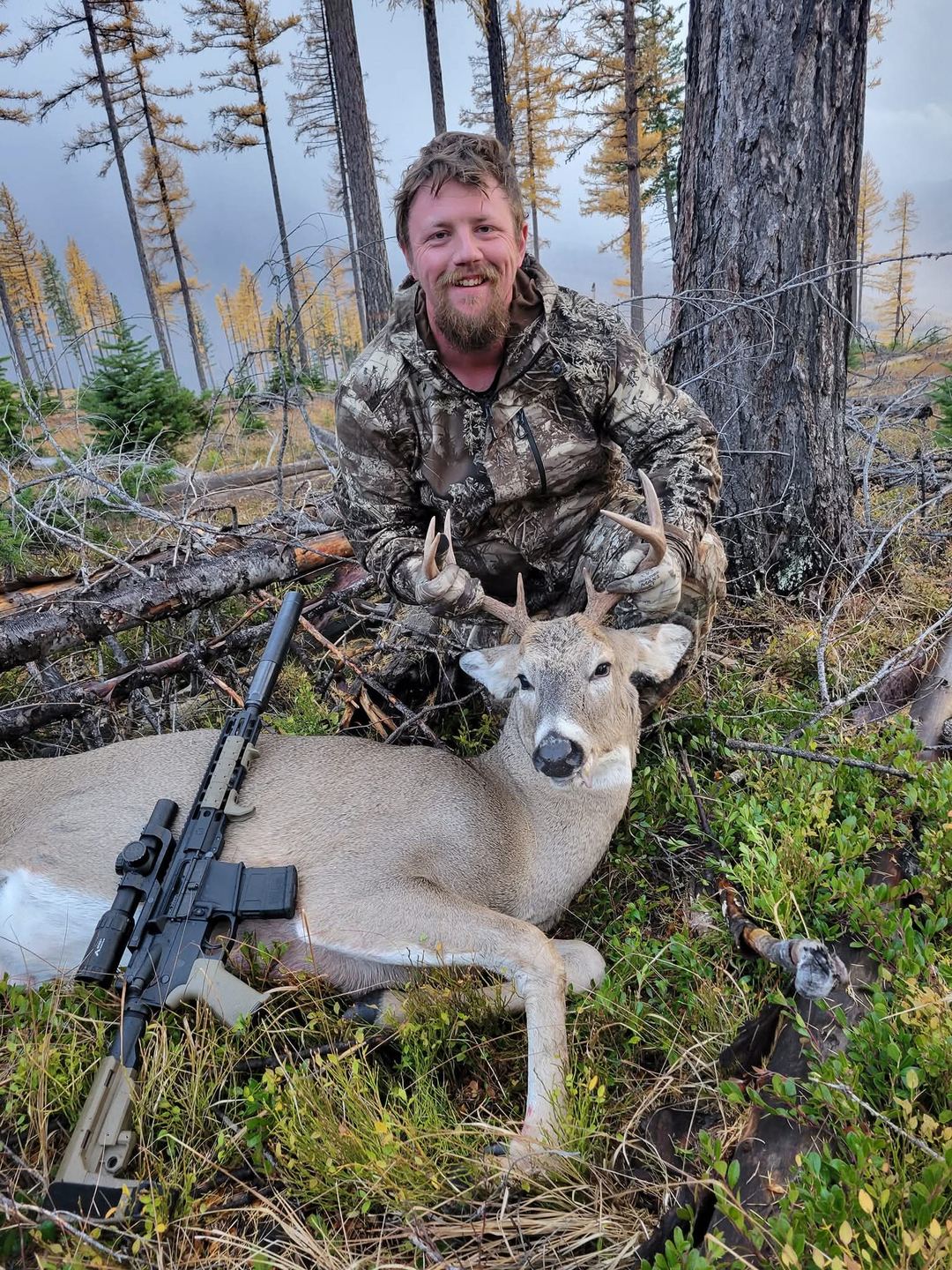
Deer. With supersonic hunting bullets and good shot placement, .300 BLK is a legitimate deer cartridge at modest ranges. That's how I use it. I hunt deer with my 10.5" suppressed .300 BLK, and I always load the Barnes 120 gr VOR-TX in the 20-round box. It's an all-copper bullet. For a sense of the numbers on a .300 BLK deer load, look at the 135 gr FTX. Zeroed at 200 yards, it drops 18.9 inches at 300, and its energy falls from 1,303 ft-lb at the muzzle to 733 ft-lb at 200 yards. Many hunters use 1,000 ft-lb as a rough guideline for deer, and by that yardstick this load is already below it at 100 yards. Energy isn't the whole story, since bullet construction and placement matter more. Still, the numbers say the same thing: treat .300 BLK as a 150-to-200-yard deer cartridge, not a 300-yard one. Inside that range, with a broadside heart-lung shot, it does the job.
Coyotes and predators. It works, especially for calling setups at close range. If coyotes are your main target, though, the flatter-shooting .223 from last week is usually the better tool.
Bigger game. For elk, moose or bear, a .300 BLK is a long way from ideal. Just because a cartridge is legal doesn't make it the right choice. We'll dig into matching the caliber to the animal in Week 13.
How it compares to the classics
Hunters have been killing deer for generations with the 7.62x39 and the .30-30 Winchester, and that's the class the .300 BLK belongs in.
- 7.62x39: Hornady's 123 gr SST runs 2,350 fps and 1,508 ft-lb from a 20" barrel, and 1,755 fps and 841 ft-lb at 200 yards. The .300 BLK 110 gr V-MAX from a shorter 16" barrel is right there with it: 2,375 fps at the muzzle and 1,834 fps / 821 ft-lb at 200. That's essentially the AK performance AAC was aiming for, but in a rifle that runs standard AR mags and a standard bolt.
- .30-30 Winchester: Hornady's 150 gr InterLock runs 2,390 fps and 1,902 ft-lb from a 24" barrel. That's clearly more muzzle energy than the .300 BLK. By 200 yards the gap narrows a lot: the .30-30 shows 1,581 fps / 832 ft-lb, and the .300 BLK 135 gr FTX shows 1,564 fps / 733 ft-lb.
In plain terms, .300 BLK is a .30-30-class cartridge, a little behind it on energy, packaged in a modern semi-auto with a detachable magazine.
Where it really earns its keep: short barrels and suppressors
The .300 BLK burns its small powder charge efficiently, so it loses less in short barrels than many rifle cartridges. In AAC's own data, a 125-grain load went 2,220 fps from a 16" barrel and 2,050 fps from a 9" barrel, a drop of only about 170 fps for cutting the barrel almost in half. AAC reported reliable function in barrels as short as 4.5 inches.
My own rifle is a good example: a 10.5" barrel with a Griffin Armament suppressor is short and easy to handle, and quieter to hunt with. I run a Primary Arms SLx 1-6x24 scope on it with the ACSS reticle made for .300 Blackout. Primary Arms' ACSS reticle for 7.62x39 and .300 BLK has bullet-drop holdovers calibrated for those cartridges, which is a better match than a 5.56 reticle. That makes a compact, lightweight hunting rifle that's easy to carry in a tree stand, a ground blind, a truck or thick brush. Pair it with a suppressor and you get a quiet, low-recoil rifle that's easier on everyone's hearing, including your dog's. A suppressor is still an NFA item, and so is a rifle with a barrel under 16 inches, so do the paperwork right. We'll go deeper on barrel length in Week 11.
The one safety rule you can't skip
Because .300 BLK uses the same case head and the same magazines as 5.56, a .300 BLK round can chamber in a .223/5.56 rifle. If it's fired, the .30-caliber bullet is trying to go down a .22-caliber bore. The pressure has nowhere to go, and the result can be a destroyed rifle and an injured shooter. SAAMI lists this as an unsafe combination, and the NRA has written plainly about the "ka-boom" pictures it causes.
If you own both, set up a system and stick to it:
- Mark your rifles. Use a dust cover, tag or band that says 300 BLK.
- Mark your magazines. Use different colored mags or marker bands for 300 BLK, and never mix them. Simple magazine identification bands make this easy.
- Keep the ammo separate. Use labeled cans and boxes, and keep only one caliber on the bench at a time.
- Look at every round as you load. The .30-caliber bullet is noticeably fatter than a 5.56 bullet.
It takes about five minutes to set up, and it prevents the one serious downside of an otherwise great cartridge.
The bottom line
The .300 Blackout gives you a .30-caliber bullet with 7.62x39 / .30-30-class performance from a regular AR-15, changing nothing but the barrel. It's at its best on hogs and deer at sensible ranges, especially from short or suppressed rifles. Choose supersonic hunting bullets for deer, use subsonics only with bullets built to expand at low speed and at close range, and keep your .300 BLK and 5.56 ammo strictly apart.
Next week: 6.5 Grendel, an AR-15 cartridge built for the opposite job, reaching out farther.
Discussion Question
What would you use a .300 Blackout for: hogs, deer, coyotes, or something else? And do you run yours supersonic, subsonic, or both?
More From This Series · Hunting with an AR-15
Week 1 · It's a Platform, Not a Caliber Week 2 · .223 Remington and 5.56 NATO Week 4 · 6.5 Grendel comingWeek 5 · 6mm ARC comingWeek 6 · .350 Legend comingThis article is for entertainment and informational purposes only. It isn't professional, legal, or safety advice. Always check the facts, local laws and regulations, and manufacturer data for yourself, and use your own judgment before you hunt or handle any firearm or ammunition.
Some links are affiliate links, which means MFS Media may earn a commission if you buy through them, at no additional cost to you.
Sources
- SAAMI .300 AAC Blackout cartridge drawing (issued 01/17/2011)
- Firearms News, "The History of the 300 AAC Blackout Cartridge" (design goals, .221 Fireball origin, speed of sound)
- Robert Silvers (AAC), "300 AAC Blackout Low Visibility Carbine," NDIA 2012 (barrel-length data, standard bolt and mags)
- American Rifleman, "Shades of Gray: .300 Whisper & .300 AAC Blackout"
- Hornady 300 Blackout 110 gr V-MAX (Hornady BLACK)
- Hornady 300 Blackout 135 gr FTX (Custom)
- Hornady 300 Blackout 190 gr Sub-X Subsonic
- Primary Arms ACSS Aurora 7.62x39/.300 BLK reticle (BDC holdovers calibrated for 7.62x39 and .300 Blackout)
- Barnes VOR-TX Rifle TAC-TX 300 AAC BLK 120 gr BT (SKU 30827; 100% copper, G1 BC 0.358; 2,100 fps / 1,175 ft-lb muzzle figures as listed by retailers, e.g. Schaefer Defense) (retailer listing)
- Barnes VOR-TX 300 AAC BLK 110 gr TAC-TX (velocity/energy via retailer listing)
- Hornady 30-30 Win 150 gr RN InterLock American Whitetail
- 7.62x39 ballistics chart (Hornady 123 gr SST)
- NRA Blog, "Avoiding the .300BLK AR-15 'ka-boom!'"
- .300 AAC Blackout overview (SAAMI unsafe-combination listing, specs)