
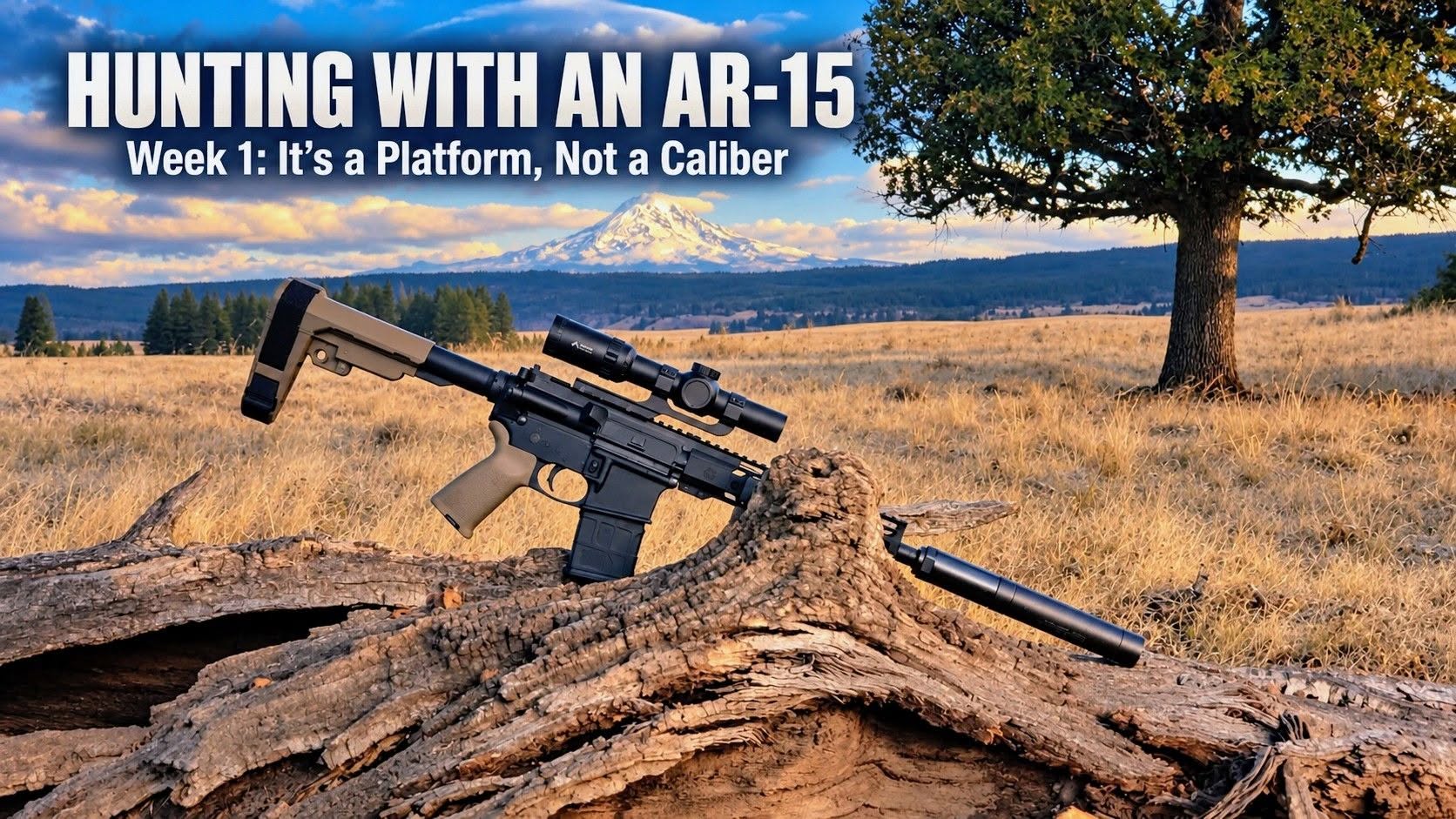
When someone says "AR-15," most people probably picture home protection, target practice, competition, or a day at the range. Those are all common uses, but the AR-15 is also a solid and highly capable hunting rifle, and the reason is simple: the AR-15 isn't one specific rifle or caliber. It's a platform.
This week we start with the foundation: how the rifle is built, why that design lets you change cartridges so easily, and where the limits are.
Two halves, one rifle
An AR-15 is built in two main halves that are held together by two pins.
The lower receiver holds the trigger group, the magazine well, the pistol grip and the stock. Under federal regulations, the lower is the part ATF treats as the receiver on an AR-15. It's the serialized part, the one that's legally "the gun."
The upper receiver holds the barrel, the bolt carrier group and the gas system. That's where the cartridge actually lives. The chamber is cut in the barrel, and the bolt face has to match the base of the cartridge.
Push out the takedown pins and the upper lifts off. Put a different upper on the same lower, and in a lot of cases you have a rifle in a different caliber. Same trigger, same stock fit, same controls, and that familiarity matters when an animal steps out.
It isn't always quite that simple. Shooting Illustrated notes that pin sizes vary slightly between makers, and any time you pair a new upper with a lower you should function-check the safety and trigger. But the idea holds: one lower, many possible rifles.
What changes when you change cartridges
Depending on the cartridge, you change one, two or three parts: the barrel, the bolt and the magazine. AR-15 hunting cartridges fall into a few families:
Standard 5.56 bolt. The .223 Remington/5.56 NATO is what most ARs come with. The .300 Blackout uses the same bolt and the same magazines; only the barrel changes. The .350 Legend also uses the standard .223/5.56 bolt face, but Winchester says it needs its own dedicated magazine. Standard .223 mags won't feed it.
Grendel-size bolt. The 6.5 Grendel and the 6mm ARC share a larger .441-inch case head, so they need a Grendel-type bolt, a matching barrel, and Grendel-pattern magazines. Hornady's 6mm ARC was built from the 6.5 Grendel, and the two use the same bolt.
Big-bore bolts. The .450 Bushmaster, .458 SOCOM and .50 Beowulf need their own barrel and bolt, and their fat cases stack single-file in a magazine, so you give up capacity:
- .450 Bushmaster uses the same .473-inch rim size as the .308 Winchester, but its overall length matches the .223's so it fits AR-15 magazine length. It runs from AR-15 magazine bodies with a single-stack follower.
- .458 SOCOM, per Wilson Combat, takes a .458-specific bolt and barrel and feeds from many standard 5.56 magazines: seven rounds in a 20-round mag, nine in a 30.
- .50 Beowulf, from Alexander Arms, needs its own barrel, bolt, gas block, magazine and a larger ejection port. Alexander Arms says its uppers fit any standard-spec AR-15 lower, but it recommends its proprietary magazines for reliable feeding.
The lower stays the same in all of these. That's the platform at work.
"Most calibers you can think of"? Here's the honest version
There are plenty more AR-15 cartridges than the eight on my list, including 7.62x39, 6.8 SPC and .224 Valkyrie. The list is long.
But every one of them has to fit the AR-15's magazine well. That puts a hard ceiling on cartridge length, about 2.26 inches overall, the maximum for a .223 Remington. It also limits how wide the case head can be before you run out of room for the bolt.
That's why cartridges like the .308 Winchester and 6.5 Creedmoor don't go in an AR-15. They're too long. They need the larger AR-10 or AR-308 style rifle, which has a bigger upper, lower, bolt carrier and magazine. Aero Precision describes its large-frame M5 as the step up from a standard AR-15 for running "more full-size rifle cartridges." AR-15 and AR-10 uppers and lowers don't interchange.
So the accurate version is this. Between the AR-15 and its bigger AR-10 cousin, the AR pattern covers a big share of the cartridges hunters actually reach for, from varmint rounds to big-bore thumpers to .308-class deer and elk rounds. But no single AR-15 does all of that, and the bigger ones aren't AR-15s.
Each cartridge is a trade-off
Every cartridge on that list gives you a different mix of velocity, bullet weight, trajectory, recoil and downrange energy.
Some shoot fast and flat with light bullets, great for coyotes and prairie dogs. Some are built to carry better at distance. The big bores hit hard with heavy bullets at shorter range. That means an AR-15 can be set up for everything from varmints and predators to deer, hogs and other game when it's paired with an appropriate caliber and hunting bullet.
That last part is the key: appropriate caliber and hunting bullet.
Chambering it doesn't make it right for the job
Being able to chamber a cartridge doesn't automatically make it appropriate for every animal or every distance.
A .223 that's deadly on coyotes at 300 yards is a very different tool on a deer at that range. A big bore that hits hard up close is a short-range cartridge by design. And the bullet matters as much as the cartridge: a fragile varmint bullet and a bonded or copper big-game bullet behave completely differently on an animal, even out of the same rifle.
The AR-15's limitations are worth stating plainly:
- Cartridge size is capped. The magazine well sets the ceiling. If you want .308-class power or more, you're into an AR-10 or a different action altogether.
- Big bores cost you capacity and reach. Single-stack magazines and heavy, slow bullets trade range for punch.
- Some conversions are more than a barrel swap. Bolts, magazines and ejection ports can all change, and mixing up parts or ammo between calibers is a real safety issue we'll cover as it comes up.
- The shooter is still the limit. Effective range is set by the cartridge, the bullet, and how well you shoot under field conditions, not by what the rifle can technically reach.
None of that is a knock on the AR-15. It's just knowing your equipment, and that's part of hunting responsibly.
What's coming
Over the coming Tuesdays, we'll break these calibers down one at a time, compare their ballistics, discuss which animals they may be suitable for, and look honestly at their limitations. Next week starts with the cartridge most ARs already wear, the .223 Remington and 5.56 NATO. Later weeks cover bullet construction, barrel length, effective range, matching the caliber to the animal, and putting together a dependable hunting AR.
The bottom line
The AR-15's versatility, accuracy, adjustability and wide selection of calibers make it much more than a range rifle. Keep the same lower and change the upper, and the rifle can be adapted to the hunter, the terrain and the game being pursued. The trick is matching the setup to the hunt, not the other way around.
Discussion Question
What caliber do you use in your hunting AR, and what game do you hunt with it?
More From This Series · Hunting with an AR-15
Week 2 · .223 Remington and 5.56 NATO comingWeek 3 · .300 Blackout comingWeek 4 · 6.5 Grendel comingThis article is for entertainment and informational purposes only. It isn't professional, legal, or safety advice. Always check the facts, local laws and regulations, and manufacturer data for yourself, and use your own judgment before you hunt or handle any firearm or ammunition.
Sources
- eCFR, 27 CFR 478.12, Definition of frame or receiver (AR-15 lower receiver)
- Shooting Illustrated, "Common Issues When Swapping AR-15 Upper Receivers"
- Winchester, 350 Legend FAQs (dedicated magazine, 2.26" overall length)
- American Rifleman, "Tested: Winchester's 350 Legend" (same case head and 2.260" max C.O.L. as .223 Rem.)
- CMMG, "What You Need to Know About the .350 Legend" (standard .223/5.56 bolt)
- Hornady, "Hornady Introduces the 6mm ARC" (June 3, 2020)
- Firearms News, "Hornady 6mm ARC Cartridge: What You Need to Know" (.441" case head, shared Grendel bolt, magazine limits)
- Alexander Arms, 6.5 Grendel Bolt Assembly (fits standard AR-15/M16 carriers)
- Alexander Arms, .50 Beowulf Tactical Complete Rifle (FAQ: standard lower, specialized parts, proprietary magazines)
- Wilson Combat, .458 SOCOM (bolt, barrel, magazine capacity)
- American Hunter, "Behind the Bullet: .450 Bushmaster" (.473" rim, single-stack magazines)
- RifleShooter, "Big Bore Upgrade: Should You Hunt Dangerous Game with an AR-15?" (.450 Bushmaster length, standard lowers, single-stack followers)
- Federal Premium, 224 Valkyrie (AR-15 cartridge)
- Aero Precision, M5/AR308 large-frame platform (.308 Win, 6.5 Creedmoor)