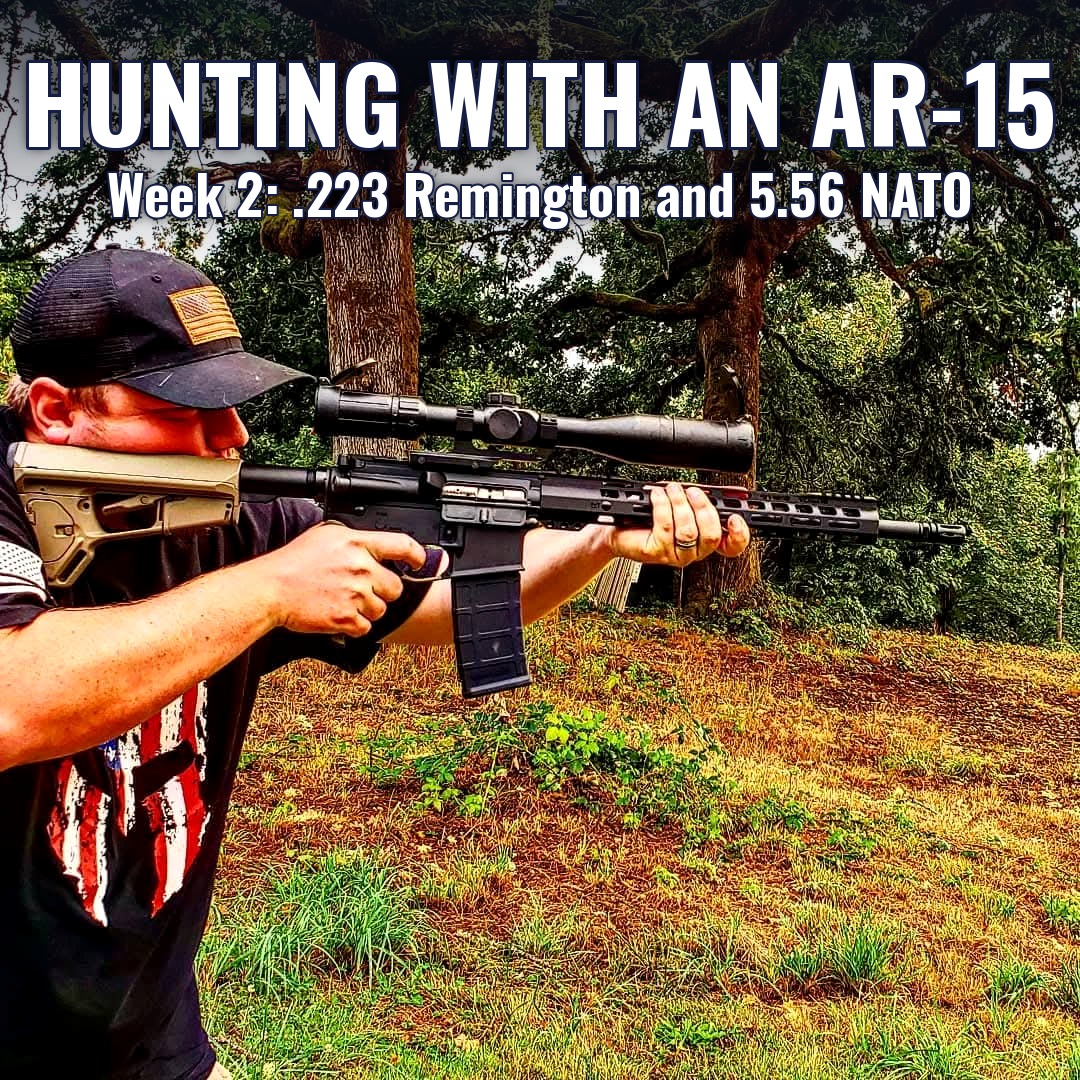
In Week 1 we looked at why the AR-15 is a platform, not a single caliber: keep the lower, change the upper, and match the cartridge to the hunt. Now it's time to talk cartridges, and the right place to start is the one most ARs already wear: the .223 Remington and its military twin, the 5.56 NATO.
Why hunters like it
Light recoil. A .22-caliber bullet over a small powder charge, fired from a gas-operated rifle, makes for very little kick. That matters more than people admit. Low recoil means less flinching, better follow-through and the chance to watch your own hit through the scope. It also makes the rifle a good fit for new and younger hunters and for anyone who's recoil-sensitive.
Speed and a flat trajectory. Hornady's 55 gr V-MAX varmint load is listed at 3,240 fps from a 24" test barrel. Zeroed at 200 yards, it's only 1.4 inches high at 100 and 7 inches low at 300. That means you can hold dead-on out to about 250 yards for most varmint work without doing any math. A 16" AR barrel will be somewhat slower than that test barrel, but the trajectory stays forgiving.
It's everywhere. Rifles, magazines, parts and ammo for this cartridge are about as common as it gets in America. You can practice a lot, and practice is what makes an ethical hunter.
What it's good for
Varmints and predators. This is home turf for the .223. Prairie dogs, ground squirrels, coyotes, foxes and bobcats are all well within what it does best. Fast, fragmenting varmint bullets like the V-MAX are built to come apart quickly on small animals, and the flat trajectory makes longer shots on small targets realistic. A light, accurate AR with a good scope is about as good a predator rifle as you'll find.
Hogs. It can work, but this is where you start being careful. A big boar has a thick, gristly shoulder plate, and a light .22-caliber bullet doesn't leave much margin for error. Use a tough hunting bullet, keep the shots close, and put them where they count: behind the shoulder or into the head and neck if you're confident of the shot. Lighter hogs are much more forgiving than mature boars.
Deer. Yes, people take deer with the .223 every year, and with the right bullet and a well-placed shot, it works. But this is the upper end of the cartridge's ability, not the middle of it. More on that below.
Why bullet construction matters so much here
With a small-bore cartridge, the bullet does most of the work. The same 55-grain bullet that's perfect on a coyote can be the wrong choice on a deer.
- Varmint bullets (like V-MAX) are designed for rapid fragmentation, in Hornady's own words. That's great for small animals. On a deer, it can mean a shallow, ugly wound and an animal that runs.
- Bonded and controlled-expansion bullets are built to hold together and drive deeper. Federal's Fusion line, for example, uses a jacket electrochemically bonded to the core for weight retention, and Federal sells a 62-grain .223 Fusion load specifically for deer.
- All-copper bullets expand and hold together without a lead core, and they're required in some areas.
- FMJ range ammo isn't designed to expand and has no place on a game animal.
For deer and hogs, pick a bullet that's designed for big game in this caliber, and heavier-for-caliber (about 60 grains and up) is generally the better direction. We'll do a full deep dive on bullet types in Week 10.
.223 vs. 5.56: are they the same thing?
From the outside the cartridges look identical, but the chambers aren't, and that's what matters.
SAAMI's guidance is straightforward:
- .223 Remington ammo in a 5.56 chamber: generally safe. A true 5.56 military-spec chamber handles .223 ammo fine. SAAMI notes there are non-standard "5.56" chambers out there, so if in doubt, check your owner's manual or ask the manufacturer.
- 5.56 ammo in a barrel marked .223 Remington: not safe. A .223 chamber has a shorter throat (leade), the distance before the bullet meets the rifling. 5.56 ammo is loaded to military pressure, and firing it in that tighter throat can drive pressure up. SAAMI warns that can result in serious injury or death and damage to the firearm.
- .223 Wylde: the best of both. Gunsmith Bill Wylde designed a hybrid chamber with the tighter .223 dimensions for accuracy and enough throat room to handle 5.56 pressure safely. A .223 Wylde barrel shoots both.
Bottom line: read your barrel. It's stamped .223, 5.56 or .223 Wylde. Match the ammo to the marking and check the headstamp on the cartridges. In an AR, switching to a 5.56 or Wylde chamber is just a barrel swap.
The limitations, honestly
This is where a lot of the arguments about the .223 come from, so let's look at the numbers.
Bullet size. A .224-inch bullet has a small frontal area. Even a well-expanded hunting bullet leaves less margin than larger calibers if the hit isn't perfect.
Energy. Federal's 62 gr Fusion MSR, a deer load designed for AR-length barrels, starts at 2,750 fps and 1,041 ft-lb. That drops to 835 ft-lb at 100 yards, 663 at 200 and 519 at 300. Many hunters use 1,000 ft-lb as a rough guideline for deer. Energy isn't everything, but a .223 is under that guideline almost from the muzzle, which tells you how little margin there is.
Range. The trajectory says the .223 can hit at long range. The energy and the bullet weight say that a deer at long range is a different story. A sensible plan for deer is a close, broadside shot, roughly inside 150 yards, with a big-game bullet. Save the 300-yard shots for coyotes.
Shot placement. With a .223, this is everything. Take broadside or slightly quartering-away shots into the heart and lungs. Pass on hard quartering-to and raking shots, shots through brush, and running animals. Being able to say "not this one" is part of hunting with a small-bore rifle.
Legality. Montana's 2026 Deer, Elk and Antelope regulations say there is "no rifle or handgun caliber limitation or magazine/round capacity restrictions" for taking game animals, so the .223 is legal for deer here. Other states set their own rules, so check before you hunt elsewhere. And legal doesn't automatically mean ideal. For elk and other big game, it's the wrong tool.
The bottom line
The .223 and 5.56 make the AR-15 a top-tier varmint and predator rifle right out of the box. With the right bullet, disciplined range limits and careful shot placement, they can also take hogs and deer. Know your chamber, match your bullet to the animal, and respect the cartridge's limits.
Next week we step up to a .30-caliber bullet without leaving the AR-15 platform: the .300 Blackout.
Discussion Question
What animals have you hunted with a .223/5.56 AR?
More From This Series · Hunting with an AR-15
Week 1 · Hunting with an AR-15 | Week 1: It's a Platform, Not a Caliber Week 3 · .300 Blackout comingWeek 4 · 6.5 Grendel comingWeek 5 · 6mm ARC comingThis article is for entertainment and informational purposes only. It isn't professional, legal, or safety advice. Always check the facts, local laws and regulations, and manufacturer data for yourself, and use your own judgment before you hunt or handle any firearm or ammunition.
Sources
- Hornady 223 Rem 55 gr V-MAX (Varmint Express)
- Federal Fusion MSR 223 Rem 62 gr
- Federal Fusion Rifle 223 Rem 62 gr (bonded jacket, deer load)
- American Hunter, "Bullet Bio: Federal Fusion"
- SAAMI FAQs (.223 Rem / 5.56 interchangeability)
- SAAMI, Generally Accepted Firearms and Ammunition Interchangeability (10/8/2021)
- Shooting Illustrated, ".223 Wylde: The Ideal AR-15 Chamber?"
- Montana FWP 2026 Deer, Elk, Antelope Hunting Regulations